

Aid is being redefined around self-interest - it doesn’t have to be

Three major international gatherings taking place across May and June are aiming to shape the future of development cooperation at a time when the aid system is under unprecedented threat.
First, the OECD hosted its Future of Development Cooperation conference in Paris last week, bringing together political leaders, senior policymakers, and civil society actors to “chart strategic directions”. This week, the UK and South African governments are hosting their Global Partnerships Conference in London “to build new international coalitions to tackle shared challenges”. Then in June the G7 will attempt to “redefine how international partnerships currently operate” during its annual summit in Évian-les-Bains, France.
Across Europe and other rich countries, governments are increasingly arguing that public resources must be redirected towards boosting economic competitiveness and responding to security threats. In this context, development cooperation is being reframed around “mutual benefit”, bringing to the forefront the argument that aid can serve rich countries’ own economic and security interests. This is a common thread running through these conferences.
This shift raises urgent questions about how we define partnerships when it comes to development cooperation - and whether poverty reduction and global solidarity are being replaced by self-interest.
Aid in the age of competition and crisis
These debates are happening against a backdrop of - and are fuelled by - the most severe cuts to official development assistance (ODA) ever witnessed. Preliminary OECD data for 2025, released in early April, confirmed that ODA is being hollowed out, with significant portions of what remains after the cuts being diverted to serve domestic and geopolitical priorities. The impact of these shifts has been profound, far-reaching, and will be difficult to reverse if aid trends continue in this direction.
Rich countries are increasingly presenting aid as politically expendable, and are justifying this through a new narrative centered on economic competition, national security and fiscal constraint.
First, they are increasingly arguing that “limited public resources” must be redirected towards boosting economic competitiveness. Sluggish growth at home, combined with competition from China and increasingly the United States, is being used to justify a more explicitly self-interested approach to international cooperation.
At the same time, national security has moved to the centre of political debate. Rising defence spending is increasingly framed as essential in the face of perceived external threats - especially from Russia. This creates an unnecessary tradeoff in which aid is presented as competition to domestic budget priorities that can support resilience and security. It is reflected in the data, which shows that 31 NATO members met or exceeded their 2% of GNI to defence targets, while most of those same countries have never met their aid spending targets.
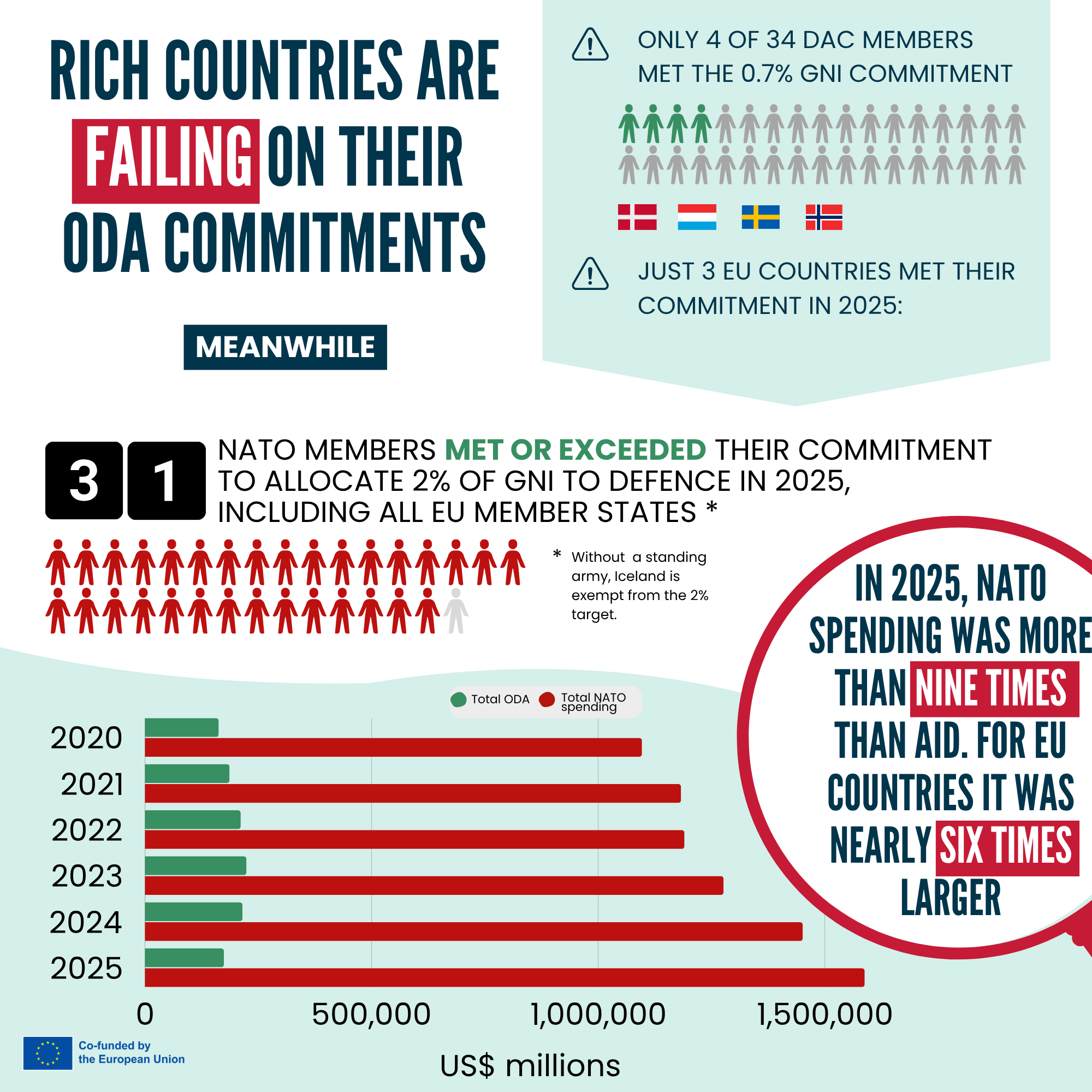
In this context, rich countries are using perceived public skepticism about aid as an opportunity to reframe development cooperation around mutual benefit.
Time for honesty…
This approach is built on public anxieties about a changing world, and on misperception and widespread overestimation of how much governments spend on aid.
Recent surveys across G7 countries show that voters believe their governments are spending somewhere between 15 and 25 times more on aid than they actually are. That shows a staggering level of misunderstanding, and it points towards a need for better communication that politicians seem keen to ignore. No government can credibly claim a popular mandate to cut budgets that the public believes are substantially larger than they are, particularly when close to three-quarters of those same respondents describe aid as a moral obligation.
Some may argue that the mutual benefit narrative is still pragmatic. But, in practice, it erodes the very purpose of development cooperation - to address the historical obligation of rich countries to redistribute the wealth it has extracted from countries in the Global South. It also runs counter to important principles that would make it more effective.
The response required now is to be honest with the public about what aid actually is, how little is spent, and the enormous impact it has; not to reframe aid as an instrument of self-interest. Rich country governments which prefer to exploit misperception rather than correct it are playing a dangerous game - one that ultimately serves neither their public, nor the people that aid is meant to reach.
…and a rebalancing of power
The aid system as it has been governed by the OECDs Development Assistance Committee (OECD-DAC) - where rich countries set their own rules, measure their own compliance, and face little to no accountability for broken promises - has already failed the people it was designed to serve. This reality is now impossible to ignore.
This creates both an urgency to respond and opportunity for transformative change. The governance of international development cooperation needs to move to a space where all countries have a voice, not just those that provide the money. There, rich countries could be held accountable for abandoning their 50-year commitment to spend 0.7 per cent of GNI on ODA. It should also be a space for a transparent debate on what counts as aid, replacing the arbitrary and often self-serving inflation of aid spending.
The core purpose of aid - reducing poverty, addressing inequalities, and supporting the countries least equipped to weather global shocks - needs to be defended on its own terms. Not because it delivers returns for rich countries, but because those rich countries have made promises that they must deliver on. The human impact of abandoning their commitments is already visible in the data and in people’s lives, and it will only continue to grow.
As we look towards the key political moments in May, June and beyond, challenging the emerging narrative and offering an alternative will be critical. The alternative must deliver greater sovereignty and democratic ownership, facilitate economic transformation and a path out of aid dependence, and deliver sustainable and people-centred development for current and future generations.