

Our verdict on FfD4: job not yet done

By the time the Fourth International Conference on Financing for Development (FfD4) opened in Sevilla, everyone already knew what the decisions would be. The final negotiation of the outcome document that turned into the Compromiso de Sevilla took place in New York behind closed doors before the conference even began. What was meant to be a milestone in addressing global economic governance was instead an endorsement of a watered-down consensus.
From the outset, the mood amongst the 1000 civil society representatives from across the world was one of deep concern. But grassroots movements, feminist groups and global coalitions arrived ready to call out the failure of the outcome document and demand real reforms - as expressed at the pre-conference Civil Society Forum; during a powerful march through the streets of Sevilla; and in an off-site youth-led Debt4Climate hub called the "Decolonial Territory". But obviously, the outcome was not what we had hoped for. From a UN Debt Convention, to the reform of how aid is governed, and the push for tax justice - the situation was clear: the job was not yet done.
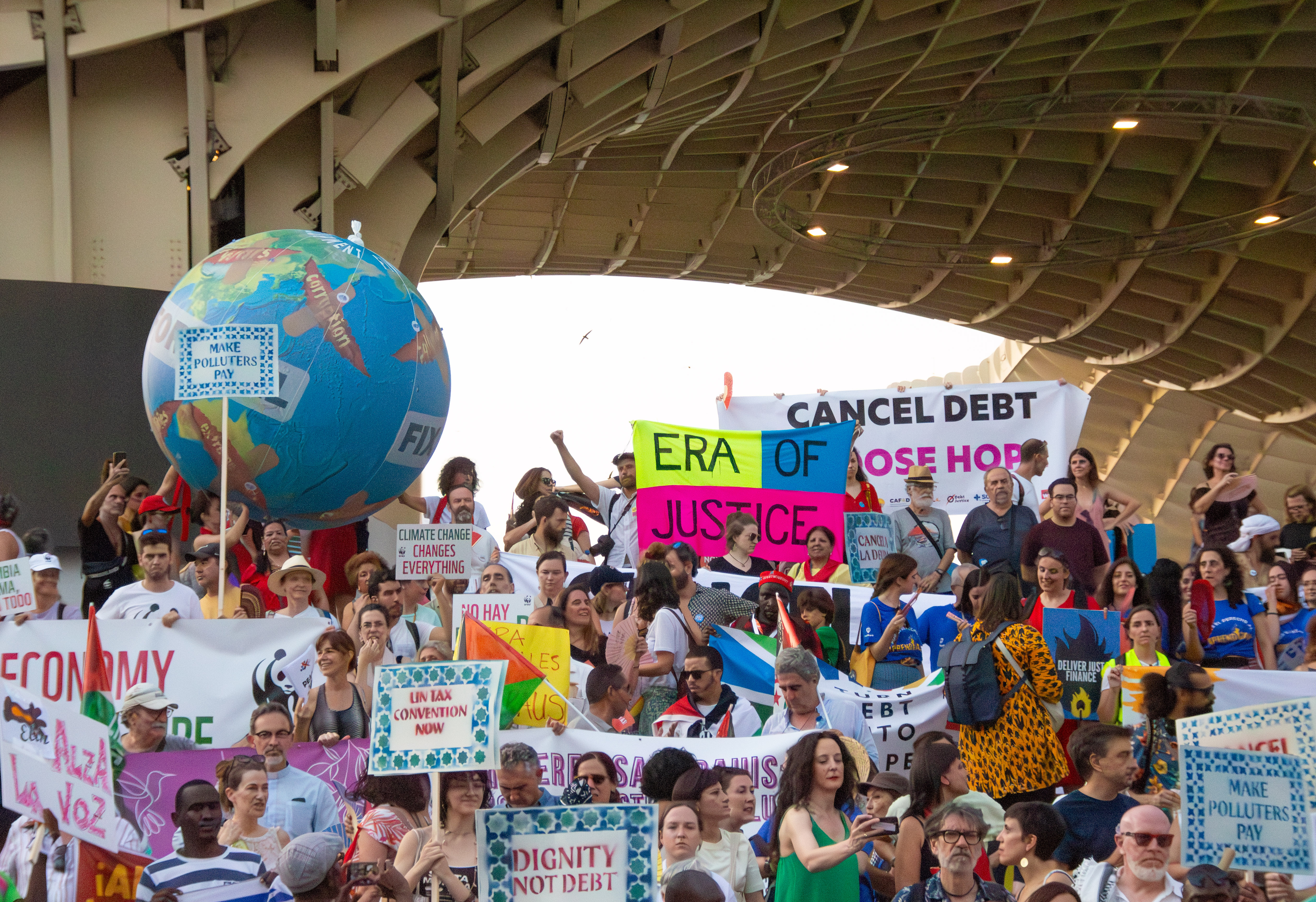 Civil Society March in Sevilla (Spain), 29 June 2025
Restricted access for civil society organisations (CSOs)
As the conference began, in a CSO room far away from where the real action was going on, frustration mounted. CSOs were only given very limited space to speak, and even saw campaign materials confiscated. We had never seen such restrictions in place at a UN conference. It soon emerged that journalists were also being restricted in their movements and access to delegates.
Adding insult to injury, the conference floor was awash with private sector delegates, who gathered at the International Business Forum and participated in the conference roundtables. They made up nearly 40 per cent of the 15,000 participants - six times the number of civil society representatives.
Civil society was not going to accept this situation lying down. Eurodad’s Tove Maria Ryding voiced the widespread concerns when she called out the lack of space for civil society on day one, in the roundtable entitled 'Mobilizing and aligning domestic public resources'. Other civil society representatives followed suit, echoing the demands for a genuine voice in the conference.
Throughout the week, we pushed our way into public-facing spaces, from Roundtable discussions, to a global and European press conference (albeit in a side room). At the very end of the conference - after days of demanding their democratic space, the civil society organisations who had come from across the world were finally allowed to hold a demonstration inside the conference venue - and make their calls for economic justice heard.
Meanwhile, private finance solutions were promoted
Nowhere was the summit’s orientation clearer than in the heavy promotion of private sector-led development. In session after session, blended finance and de-risking dominated the conversation. A representative of the private sector lending arm of the World Bank Group reminded the audience at the Roundtable on “leveraging private business and finance” of the words of its president, Ajay Banga: “Official Development Assistance is a rounding error compared to the trillions needed to achieve the Sustainable Development Goals.” This was the argument used to justify the relentless promotion of private investment in development and climate-related projects.
And this included the promotion of the EU’s Global Gateway, an investment strategy aimed at using (scarce) development resources to attract private investment in infrastructure projects.
The “Sevilla Platform for Action” launched 130 initiatives which are supposed to operationalise the outcome document - from risk insurance tools to debt-for-development swaps. Many relied on market-based solutions, with few accountability mechanisms in sight.
For the CSOs, this was déjà vu, following the ‘billions to trillions’ mantra first pushed by the World Bank 10 years ago. This was money that was supposed to come from the private sector that never materialised. Rodolfo Lahoy of IBON International put it bluntly during his Roundtable intervention: “Private finance and large capital are treated as life-vests of a sinking development agenda, despite contrary evidence of corporate abuse and rights violations in the Global South.”
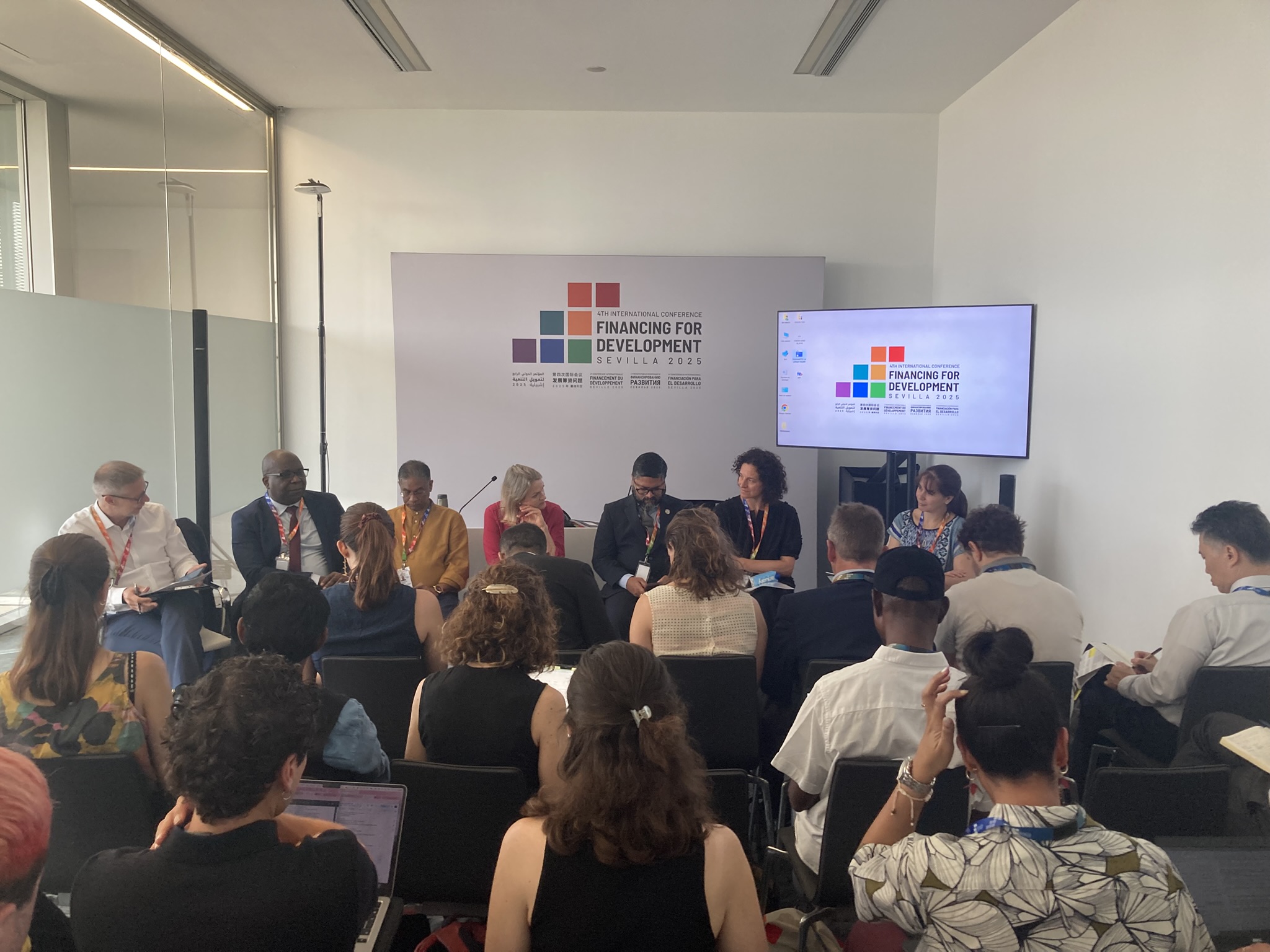 Side event of the Fourth International Conference on Financing for Development (FfD4): ‘A Global Public Development Bank Ecosystem, Climate-Aligned Finance, and the Right to Development’, 1 July 2025
Civil society pushed hard against this agenda throughout the week, and will continue to disentangle the myth of private finance, calling for public finance to be recognised as the main driver of development and not as a residual safety net for market failures. This also implies elevating the developmental and regulatory role of the state, including by promoting green industrial policies that aim for socio-economic transformation of countries of the Global South.
Looking ahead: A movement reignited
Sevilla may not have delivered on its promises, but it has certainly reignited civil society’s commitment to systemic reforms. We are also intent on using the windows of opportunity that the outcome document provides to push for a strong follow-up, such as an intergovernmental process to review the gaps in debt architecture or the setting-up of a borrowers platform, and a commitment to revitalise the UN Development Cooperation Forum. With 2025 marking a Jubilee year, campaigns for debt cancellation and a UN debt convention will continue at full force, and so will the call for a space under the UN to govern international development cooperation.
Meanwhile, the issue of tax provides a reminder that real change can happen on the FfD agenda. For many years,CSOs used this space to campaign for all countries to have a seat at the table when global tax rules are decided, and at the end of 2024, the UN General Assembly finally adopted the mandate for the negotiation of a new UN Convention on Tax. The negotiation of this convention, as well as two early protocols, will begin in August 2025. Together with the Global Alliance for Tax Justice and the Civil Society Financing for Development Mechanism, Eurodad will be there to continue the fight for a fair and ambitious convention.
The fact remains that the UN is the only space in which all countries can participate on an equal footing, and where CSOs can even hope to obtain a real democratic space and truly inclusive and ambitious reforms. That does not mean that we will always welcome everything that comes from the UN. On the contrary - because this organisation is so unique and important, it is even more crucial to keep up the fight for democratic space and high ambition.
CSO cries did not go completely ignored in Sevilla. At the final press conference of FfD, the UN Deputy Secretary-General Amina Mohammed acknowledged the shortcomings and the lack of space for civil society during FfD4, saying: “We hear you and we endeavour to work with Member States to see the space expanded.”
Civil society will be following up on this promise and will continue the fight for a global economic system that represents - and delivers for - all.

CSO's demonstration at the Fourth International Conference on Financing for Development (FfD4), 3 July 2025 - Click here to view the photo album (via Flickr)