Join Eurodad and partners at the CSPF and WBG/IMF Spring Meetings 2026

Share

Join Eurodad and partners at the Civil Society Policy Forum and World Bank Group - International Monetary Fund Spring Meetings this April.


14 April
11.00 UTC-4

Strained multilateralism: Post-Seville commitments, IMF responsibilities and a rights-aligned economic order

Organised by Center for Economic and Social Rights (CESR); MENA Fem Movement for Economic, Development and Ecological Justice (MENA Fem); Human Rights Watch (HRW); Latindadd; Bretton Woods Project (BWP); Resilient40, Global Policy Forum Europe; Recourse; Eurodad; Asian Peoples’ Movement on Debt and Development (APMDD); Initiative for Social and Economic Rights (ISER).

Multilateral cooperation is under strain at a time when global debt distress, tax negotiations, climate disasters, and widening inequality demand coordinated responses. Building on sessions co-led by CESR and partners at recent Spring and Annual Civil Society Policy Forums, this panel advances discussion on the IMF’s responsibilities within a fragmented global governance landscape. Connecting the dots across forums and processes, it will follow up on post-Seville commitments on debt architecture, evolving orientations on global tax cooperation, and the IMF’s role in climate finance debates linked to COP processes and broader proposals to reform the global financial architecture. While collaboration across institutions is often emphasized, gaps remain in aligning IMF programs and macroeconomic policy advice with international human rights standards and gender-responsive and climate-aligned commitments. This session will examine those tensions and explore how multilateral cooperation can become more coherent, accountable, and rights aligned. Crossfield experts will bring in proposals from global, regional and country level perspectives.

Speakers:

  • Moderator: Mahinour ElBadrawi Global Partnerships Lead Center for Economic and Social Rights (CESR)
  • Shereen Talaat Director MENA Fem Movement for Economic, Development and Ecological Justice
  • Daniela Berdeja Ruiz Senior Policy Advisor Latindadd (Red Latinoamericana por Justicia Económica y Social)
  • Robert Powell, Special Rep to the UN, IMF


Watch here

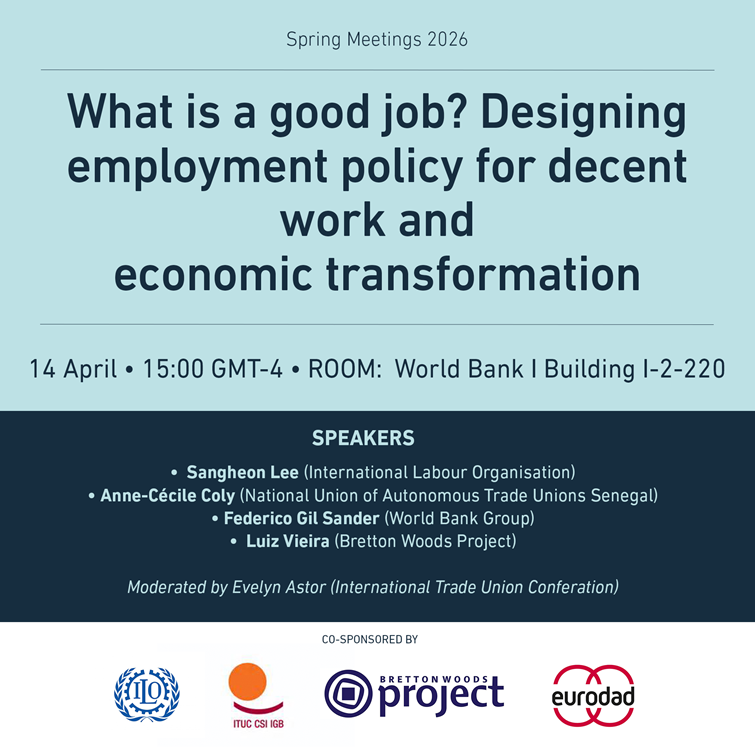
14 April
15.00 UTC-4

What is a good job? Designing employment policy for decent work and economic transformation

Co-organised by International Trade Union Confederation, International Labour Organization, Bretton Woods Project, Eurodad.

Jobs are at the center of the World Bank Group’s strategy for economic development, but exactly what kinds of jobs? As the World Bank Group finalizes its “More and Better Jobs” indicator, we will discuss approaches to measuring job quality that promote decent work, support formalization, and enable socio-economic transformation.

Speakers:

  • Moderator: Evelyn Astor, Director of Economic and Social Policy, ITUC
  • Anne-Cecile Coly, Vice President, UNSAS Senegal
  • Sangheon Lee, Director of Employment Policy, ILO
  • Luiz Vieira, Coordinator, Bretton Woods Project
  • Federico Gil Sander, Manager, Jobs and Growth (Prosperity), World Bank

Watch here

14 April
16.30 UTC-4

Towards greater coherence between fiscal and monetary policy

Co-organised by LATINDADD, Foundation for the Development of Central America (FUDECEN), Jubilee USA Network, European Network on Debt and Development (EURODAD), Center for Economic and Policy Research (CEPR), MENAFem, Mexican Crisis Observatory (OMEC).

This event proposes an exchange on the interaction between fiscal policy and monetary policy developing economies, considering the challenges they face in responding to various shocks. Drawing on recent experiences, the discussion will examine how different institutional arrangements influence policy effectiveness and their capacity to support macroeconomic stability, sustainable development and inclusive growth, and what has been the role of IBWs in this issue. The panel will also explore under what conditions greater alignment and communication between fiscal and monetary authorities can strengthen debt sustainability, improve access to local-currency financing, and enhance resilience to episodes of exchange rate volatility.

Speakers:

  • Moderator: Patricia Miranda, Global Advocacy Director, LATINDADD
  • Oscar Cabrera, former President of the Central Reserve Bank of El Salvador and President of FUDECEN
  • Mark Weisbrot, Co-director, Center for Economic and Policy Research (CEPR)
  • Carolina Osorio Buitron, Senior Economist, IMF

Watch here

15 April
14.00 UTC-4

The IMF review of conditionality: Putting the IMF’s money where its research is

Co-organised by The Tahrir Institute for Middle East Policy; Arab Watch Coalition (AWC), Global Social Justice, International Trade Union Confederation (ITUC), Arab NGO Network for Development (ANND), WEMOS, Third World Network, TA’AFI Initiative, Noria Research, Gherbal Initiative, Egyptian Front for Human Rights, MENA Fem Movement for Economic, Development and Ecological Justice, Global Coalition for Social Protection Floors (GCSPF), Human Rights Watch, EuroMed Rights, Bretton Woods Project, Syrian Center for Policy Research, The Center for Egyptian Women's Legal Assistance, Shirakat Foundation, Success Capital Africa, Malcolm H Kerr Carnegie Middle East Center, Refugee Platform in Egypt, Arab Reform Initiative, Al Bawsala, The Sanaa Center for Strategic Studies, Egyptian Human Rights Forum, The Egyptian Commission for Rights and Freedoms, Recourse, Badil.

IMF publications regularly note austerity’s counterproductive impact on growth and macroeconomic stabilization while acknowledging benefits of progressive fiscal policies, and the need to integrate political-economic analysis, distributional impact assessments, and country-specific policies into programs. However, these findings are rarely reflected in programs. Consequently, over-optimistic growth and debt sustainability targets are regularly missed, reforms derailed, making macroeconomic stabilization elusive. This session will leverage country case studies with IMF and independent research to show how shifting to expansionary reforms, informed by country-specific expertise sensitive to political-economic realities, allows the IMF to operationalize its findings through the Review of Conditionality for greater success.

Speakers:

  • Moderator: Hossein Cheaito, Researcher, Arab Watch Coalition,
  • Tim Hirschel-Burns, Policy Liaison, Boston University Global Development Policy Center
  • Rabie Nasser, Co-Founder and Director, The Syrian Center for Policy Research
  • Sarah Saadoun, Senior Advisor on Poverty and Inequality, Human Rights Watch
  • Timothy E. Kaldas, Deputy Director, The Tahrir Institute for Middle East Policy
  • Irene Yackovlev, Senior Economist, IMF

Watch here


16 April
15.00 UTC-4

Spillover effects: The fossil fuel–debt trap in the Global South

Co-organised by MenaFem Movement for Economic, Development, and Ecological Justice, Fossil Fuel Treaty, Oil Change International, Recourse, Eurodad, Asian Peoples' Movement on Debt & Development, Caribbean Policy Development Centre, Center for Egyptian Women’s Legal Assistance (CEWLA), Big Shift Global, Debt Justice Norway, Christian Aid.

This event will present and discuss the outcomes and recommendations of the report Spillover Effects: The Fossil Fuel–Debt Trap in the Global South which explores the relationship between sovereign debt and fossil fuel dependence in Egypt, Jordan, Sri Lanka, Colombia, and Guyana.

Speakers:

  • Moderator: Shereen Talaat, Director, MENAFem Movement
  • Habiba Fouad, Climate and Economic Justice Officer, MENAFem Movement
  • Ali Nasrallah, Policy and Research Manager, Fossil Fuel Treaty
  • Jwala Rambarran, Senior Advisor, Caribbean Policy Development Centre
  • Camilo Rodríguez, Research Analyst, Oil Change International
  • Igor Zuccardi, Economist, Strategy Policy & Review, IMF

Watch here

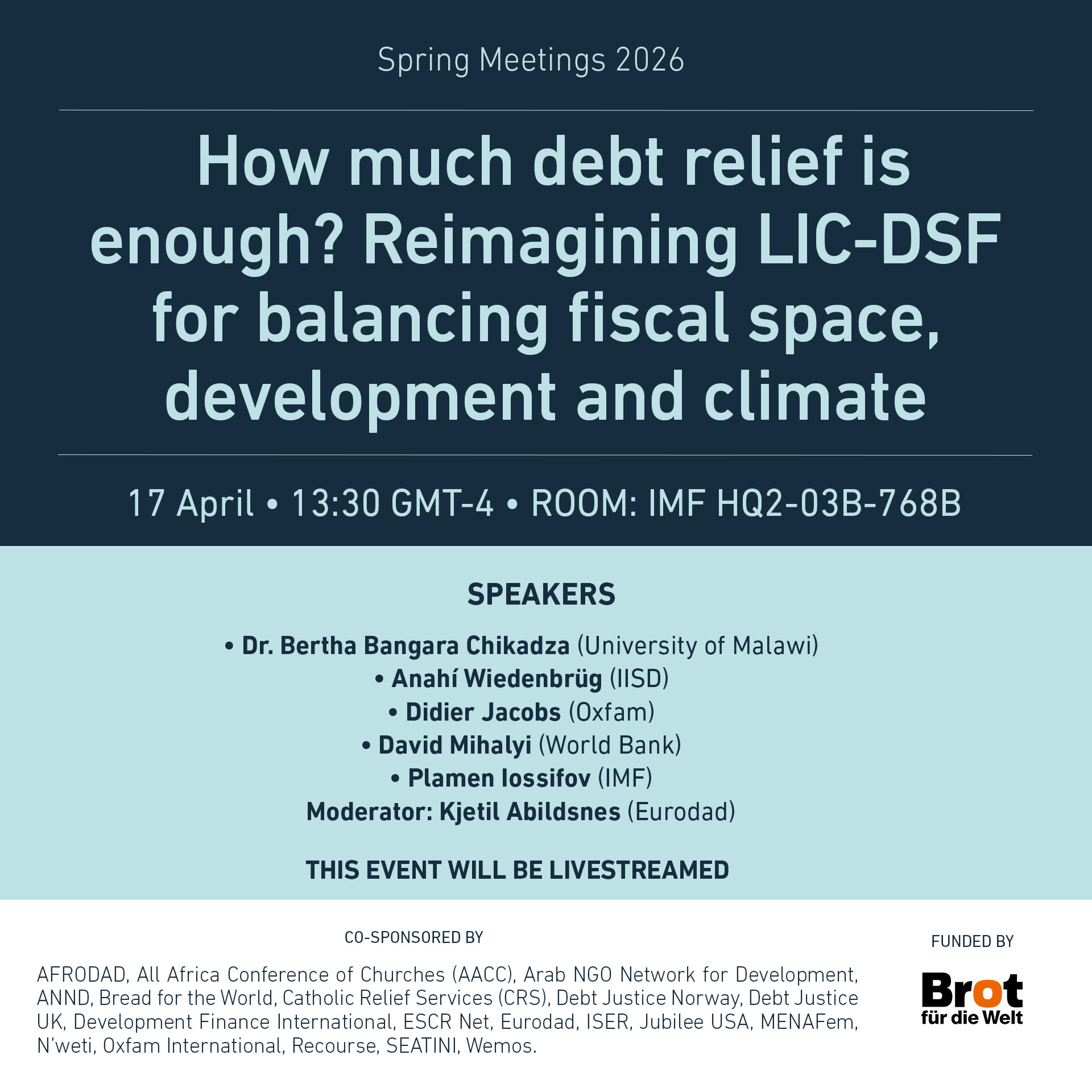
17 April
13.30 UTC-4

How much debt relief is enough? Reimagining LIC-DSF for balancing fiscal space, development and climate

Co-organised by AFRODAD, All Africa Conference of Churches (AACC), Arab NGO Network for Development, ANND, Bread for the World, Catholic Relief Services (CRS), Debt Justice Norway, Debt Justice UK, Development Finance International, ESCR Net, Eurodad, ISER, Jubilee USA, MENAFem, N’weti, Oxfam International, Recourse, SEATINI, Wemos.

The IMF and WB are about to complete their review of the Debt Sustainability Framework for Low-Income Countries (LIC-DSF). This is the model that de facto determines how much debt relief countries facing debt restructuring get. It is critical to get it right, both to prevent debt crises and to avoid that countries in debt distress end up overindebted, even after debt restructurings. This session will be an opportunity to debate possible improvements into the LIC DSF, focusing on how it can better reflect the debt vulnerabilities. Furthermore, participants will share how the framework should capture increasing climate change vulnerabilities.

Speakers

  • Moderator: Kjetil Abildsnes, Senior Policy and Advocacy Officer, Eurodad,
  • Dr. Bertha Bangara Chikadza, Senior Lecturer, University of Malawi
  • Anahí Wiedenbrüg, Senior Policy Advisor, International Institute for Sustainable Development
  • Didier Jacobs, Development Finance Lead, Oxfam International
  • Plamen Iossifov, Deputy Division Chief, IMF
  • David Mihalyi, Senior Economist , World Bank Group

Watch here


These events are being produced with the financial assistance of the European Union. The contents of these events are the sole responsibility of Eurodad and its partners and can in no way be taken to reflect the views of the funders.