

2026: Striving for justice in an age of self-interest

In a world increasingly marked by self-interest and the dominance of power over principle, it is hard to be optimistic. However, our collective struggles last year led to some victories, and 2026 presents plenty of opportunities to overcome this peak era of imperialism.
With the US military operation in Venezuela and threats to intervene by force if needed in other sovereign territories, the US President’s Executive Order to withdraw from 66 international organisations and the protests in Iran, it is hard to believe that we are only two weeks into the new year. The brutality and impunity with which the US is setting aside international law or commitments to international organisations is astounding.
The flagrance of US action aside, they represent the continuation of decades of US foreign policy and its imperial project. Most recently, in the financing for development arena in 2025, the US chose to step out of negotiations of the UN Tax Convention and the outcome of the fourth International Conference on Financing for Development.
Despite the opportunities for progressive groups of countries to step up and act in 2025 we did not see this happen.
The question now is how the rest of the world will respond as we enter 2026. Will it recognise the urgency of action to deal with the current polycrisis or be paralysed? Will it descend to the lowest ambition in the struggle to defend multilateralism? And will progressive groups finally rise up to the occasion and demonstrate vision and leadership?
2025: A year of missed opportunities
Civil society had warned that the G20’s Debt Service Suspension Initiative (DSSI) - the global response to the debt crisis in 2020 - was merely kicking the can down the road and that without debt cancellation and reform of global debt governance, the debt crisis would only get bigger. Sure enough, 2025 witnessed a record number of debt restructurings. The latest International Debt Report, published by the World Bank in December 2025, revealed that Global South countries have paid out the highest amounts on their debt in 50 years. Between 2022-24 countries paid US$741 billion more in debt than they received in new financing. On the other side of the coin, aid is in free fall, declining for the first time in seven years in 2024, with several donors announcing further cuts to their development budgets.
The direct consequence of increasing debt payments and decreasing aid and other new financing is that public budgets are being squeezed, public services decimated and climate action made impossible. Austerity is the new normal.
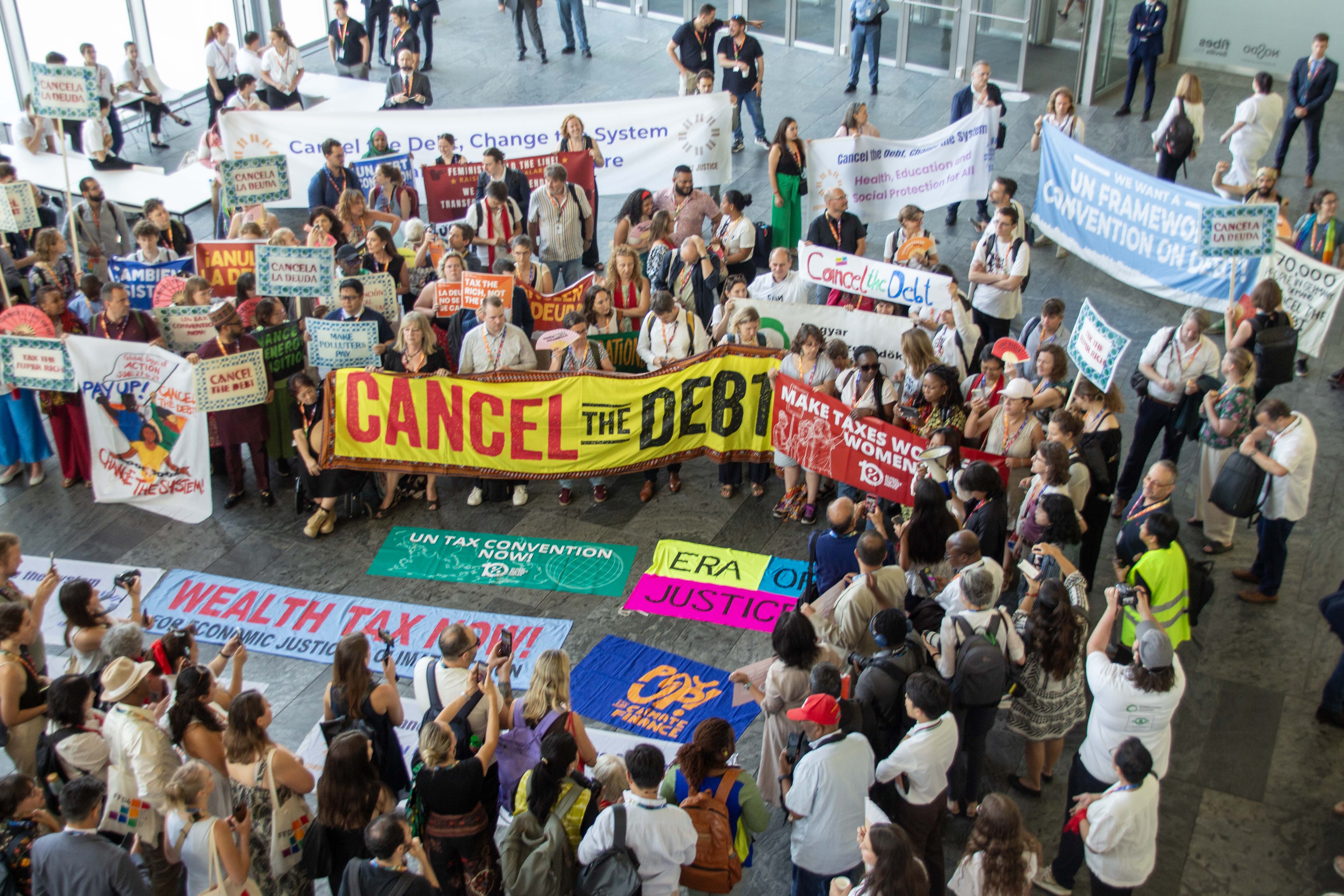
Civil society activists at the fourth Financing for Development Conference in Sevilla
A fitting response to these crises would have been the structural reform of global economic governance that the economic justice movement advocated for at the fourth Financing for Development Conference (FfD4) in July 2025. However, despite the negotiations beginning with high ambition, this was watered down in order to reach a consensus, resulting in the ‘Compromiso de Sevilla.’ So instead of opening the door to the urgently needed space to forge a new UN Debt Convention or reform the governance and accountability framework for international development cooperation, only small windows remain to advance the reform agenda - frustratingly slower than what is required.
Ultimately, FfD4 became all about fast-tracking private-sector led development. This agenda, which rests on the notion that private investment will miraculously provide the missing billions that are urgently needed to meet development and climate commitments, continues to be promoted relentlessly. This is despite the fact that private investment promised by the ‘billions to trillions’ agenda of the World Bank a decade ago never materialised.
In this vein, the EU stepped up its Global Gateway strategy in 2025. This included the launch of the Global Gateway Investment Hub, a new platform for European companies to participate more easily in shaping policy priorities and identifying strategic projects. In practice, this is a blow for those who are calling for the Global Gateway to no longer be Brussels-driven and instead more driven from Global South countries themselves. Indeed, the EU seems willing to sacrifice its treaty commitments to eradicate poverty in order to join the broader shift to turn development into a transaction, continuing centuries of colonial extraction of raw materials.
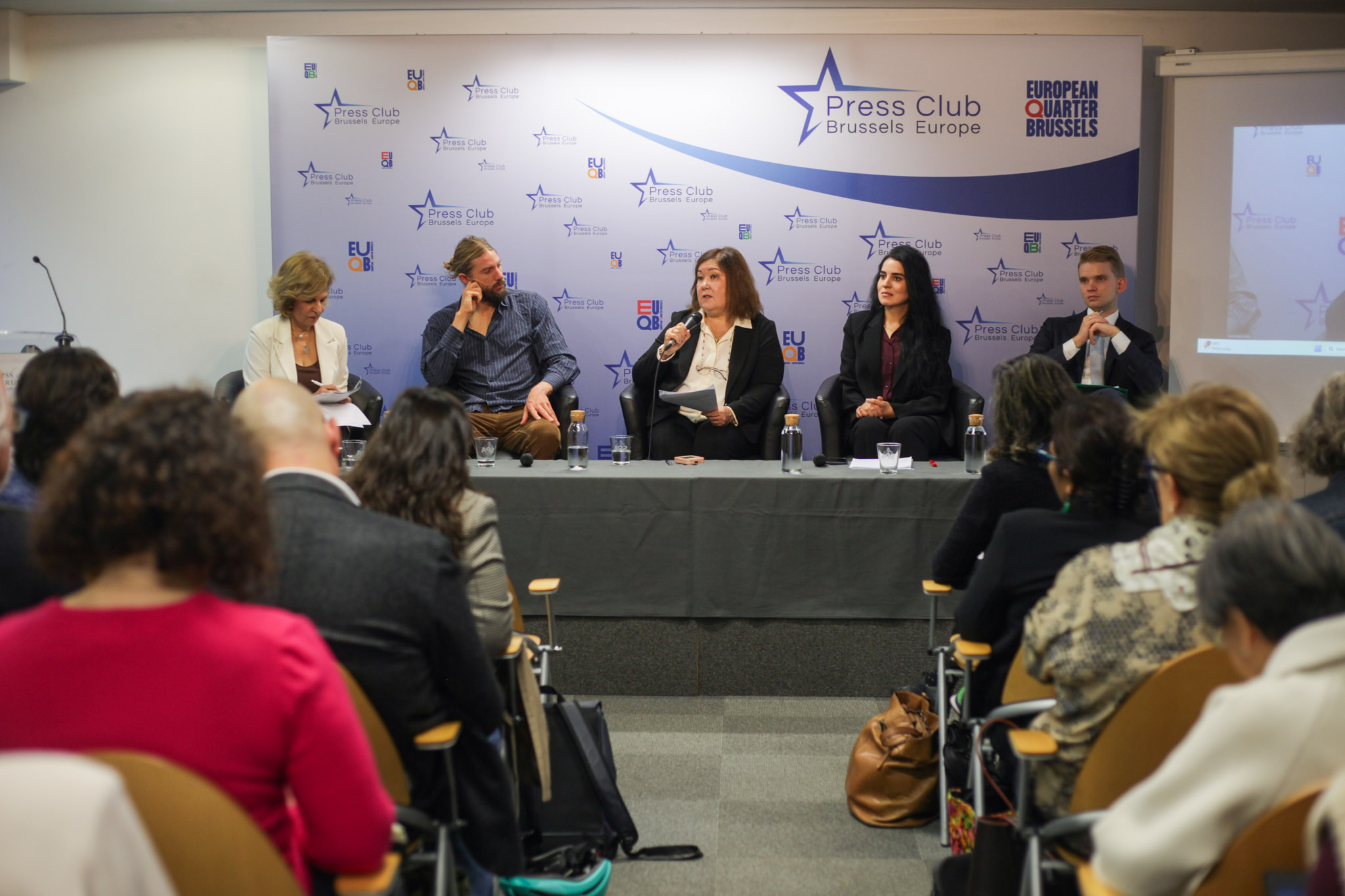
Panellists at a Eurodad, Counter Balance, Oxfam, Action Aid and CONCORD Europe event on the Global Gateway in October 2025 at the Press Club in Brussels.
Holding the line in 2026
Despite the slowdown or even backsliding of progress on our economic justice goals, we must not lose sight of our movements’ achievements. They blaze a trail of new energy and hope for 2026.
While its outcome was a mixed bag, COP30’s agreement to develop a just transition mechanism - the Belem Action Mechanism - was a victory for workers and social movements in the Global South - one they have worked very hard for.
Another important landmark for the economic justice movement was the start of collective negotiations on the substance of the UN Convention on International Tax Cooperation. These kicked off in August in New York and continued in November in Nairobi.
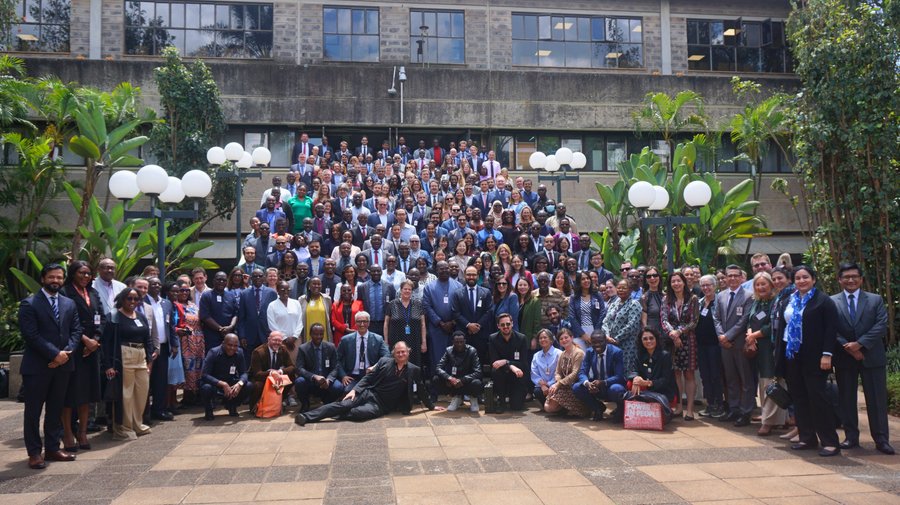
The Civil Society delegation at the negotiations in Nairobi
There is, however, still much to be done in 2026 as neither the tax negotiations nor progress on the Paris Agreement are perfect. We look then to the coming rounds of UN Tax Convention negotiations, where 2026 will be an absolutely crucial year, which will determine the level of ambition in the future global tax agreement. We also look to the next climate summit COP31, hosted in Türkiye, with a joint presidency shared with Australia, and at new opportunities such as the first International Conference on the Just Transition Away from Fossil Fuels, hosted by Colombia and the Netherlands. Eurodad is in full planning mode internally, with our members and in our global alliances, to define our plans for these events.
This new year also marks the launch of a new campaign to mobilise young people in Europe to advocate for climate and tax justice, led by CNCD-11.11.11 and supported by Eurodad and our members. This is the second phase of our broader “Era of Justice” campaign launched in 2025, and will build on the valuable partnership with young people developed during the UN Tax Convention negotiations and at COP30. This can be followed on social media using #eraofjustice.
Equally, there are important opportunities for the economic justice movement to turn the tide of political indifference and breakdown of solidarity. Negotiations of the next EU development budget (the so-called Multiannual Financial Framework or MFF) for the period 2028-2034 will reach their final stages in the coming year. This will be a decisive moment for the future of development cooperation in Europe.
Civil society will also continue to advocate for a UN-led forum to set the norms and rules on aid, alternative to the exclusive rich countries-dominated OECD-DAC. Additionally, the Bretton Woods Institutions’ Annual Meetings in Thailand will provide further opportunities to highlight the need to reform global economic governance, which is dominated by rich countries.
Following the “Sevilla Commitment” at FfD4, in 2026 we will see the first steps of a Borrowers’ platform and the setting-up of a Working Group under the UN on responsible lending and borrowing. The UN should also initiate, as agreed in Sevilla, an intergovernmental process to make recommendations for closing gaps in the Debt Architecture. In the absence of a fair debt restructuring mechanism, we will continue to see countries opting to deepen austerity, rather than defaulting and facing debt restructuring. We are also very likely to see private creditors redoubling their efforts to get as much as possible from debt distressed countries, as in Venezuela and Ethiopia in 2025. This situation will probably lead to more social unrest and an increase in mobilisations, continuing the GenZ uprisings of last year.
In a year that has already begun with uncertainty, there are some uncomfortable certainties. Firstly, the polycrisis will rage on, with the Global South bearing the greatest brunt. The countries most responsible for the polycrisis will continue to rescind their responsibilities, racing each other to the bottom, to extract the resources they need to secure their prosperity. The third certainty is the challenging environment in which civil society must operate. Many of Eurodad’s members, partners and allies are being forced to scale down their work and reduce their staff by development budget cuts. Groups defending gender equality, the environment, migrants and asylum seekers’ rights are on the frontline of hostility and attack.
Yet, as we have demonstrated time and again, civil society will continue to work together, against all odds, to strive for the advent of an era of justice.
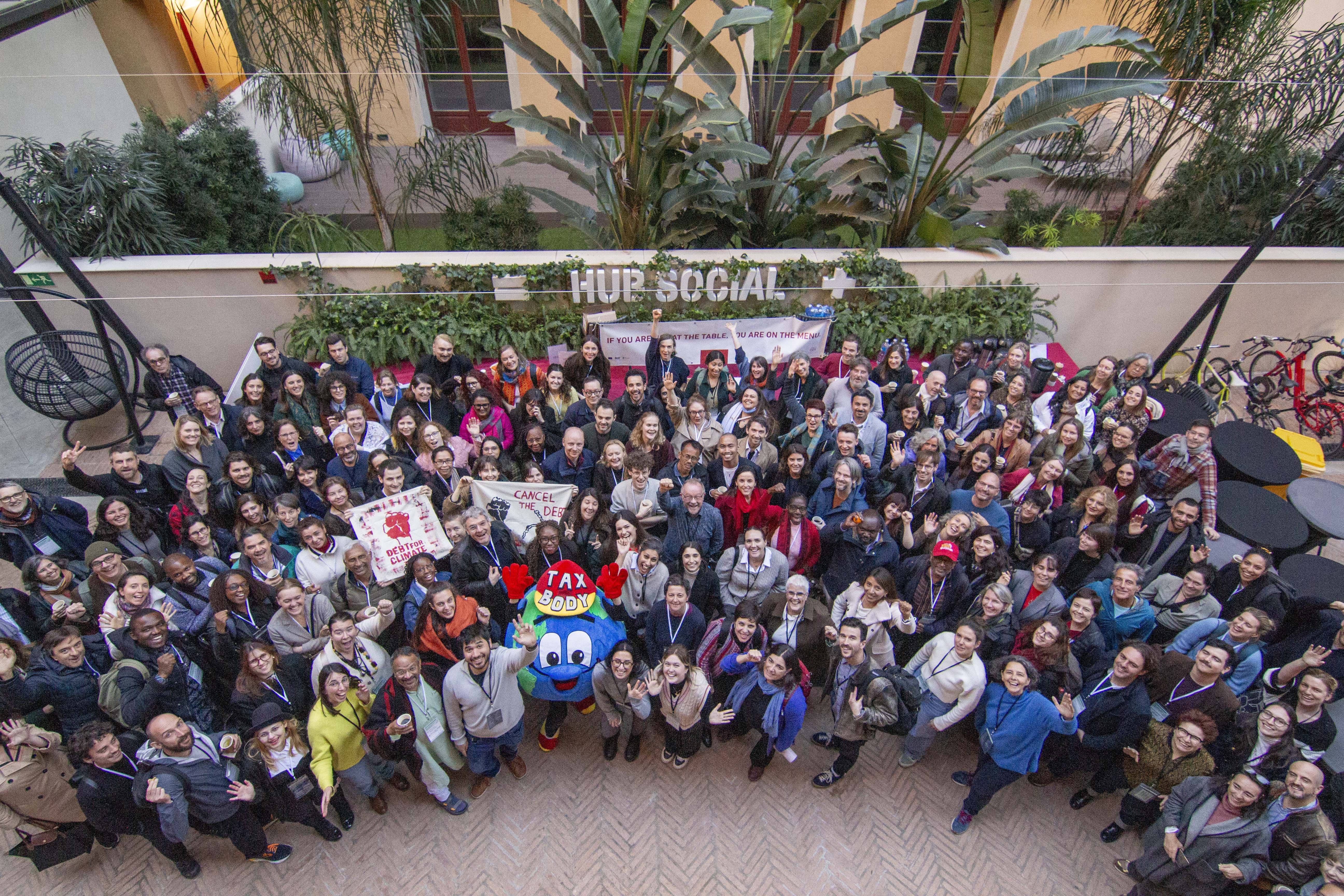
Delegates at the Eurodad International Conference in Barcelona in January 2025